The modern law firm has never had more software. Practice management. Case management. Document management. Time recording. E-bundling. E-signing. E-Discovery. Portals. Workflow automation. Precedent systems. Client intake. Courts portals. Compliance platforms.
And yet, if you ask a partner a brutally simple question like “Where does client data go, end to end, and what’s the control story?” you’ll often get straight to the heart of the issue. There are systems in place but there is not an overall coherent system.
This is the readiness gap. It happens when firms adopt technology in ways that don’t line up with the nature of the work or with the firm’s ability to control, audit, secure and explain what happens inside those tools.
Professor Richard Susskind OBE is one of the most influential writers on how technology reshapes legal work and is known for turning big predictions into practical operating models that partners can use. In the late 1990s, after crystallising his view that IT would fundamentally change law, he developed the Grid to help lawyers think through IT strategy by mapping how legal data, information and knowledge are handled inside firms and shared with clients.
Susskind’s Grid is the antidote to the readiness gap because it forces a discipline most legal tech roadmaps avoid; it makes you place every capability in its correct strategic zone. And the moment you do that, a pattern emerges that’s incredibly consistent across firms
Firms leap upwards and rightwards on the grid towards client facing systems and online services without having built the internal foundations on the left and bottom.
The result is predictable. The front end looks polished but underneath you get inconsistent data, unclear ownership, patchy controls and failures that only surface when a client query, a deadline or an incident forces the system to prove it actually works.
The Grid Applied
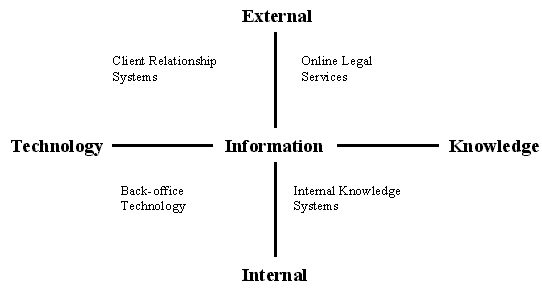
1) Back-office technology
This quadrant is not exciting, which is why it is chronically underbuilt, but this is where your firm earns the right to do almost everything else.
Back-office technology is the plumbing: networks, devices, access control, identity management, secure configuration, backups, logging, patching, email hygiene, document storage conventions, permissions, segregation of matters, vendor management – the conditions under which client data is processed predictably.
Susskind’s Grid treats this as foundational for a reason. If this quadrant is weak, then every shiny system above it becomes a compliance gamble because you can’t prove who accessed what, what left the environment, what was changed or how an incident would be reconstructed.
Legal tech readiness begins here because compliance is not a policy. It’s an architecture.
2) Internal knowledge systems
If back-office is plumbing, internal knowledge systems are the firm’s memory made searchable, versioned and repeatable.
This quadrant is where precedents move from being scattered and person dependent to being organised, maintained and consistently usable across the firm so the quality of work doesn’t hinge on who happens to be involved. It’s knowledge management but also process intelligence: playbooks, checklists, clause banks, matter archetypes, training data, internal guidance, and, crucially, governance around “what counts” as approved.
The readiness gap shows up here when firms buy knowledge tools without the discipline required to make them trustworthy. It shows up as no document taxonomy anyone follows, no ownership of templates, no versioning, no retirement process, no agreed “source of truth.” So the firm ends up with a paradox: more knowledge artefacts, less confidence.
The Grid explains why this happens. Put simply, you can’t build durable knowledge on top of chaotic information flows.
3) Client relationship systems
This is where legal tech becomes visible to clients. Portals, status trackers, matter dashboards, secure messaging, automated updates, intake and onboarding, e-billing interfaces, document sharing.
Susskind places client relationship systems in the external zone because their strategic purpose is not internal efficiency – it’s service experience and relationship management.
And this is where many firms accidentally create a new kind of risk. They treat relationship systems as just a nicer interface without noticing they’ve just created an obligation to be consistently accurate, timely, and traceable.
The client portal doesn’t just show progress. It commits the firm to a narrative of progress. If your internal workflow is informal and your file is scattered across inboxes and desktops the portal becomes a beacon pointed directly at your operating reality. This is why client facing tech often fails politically inside firms. Not because clients don’t want it but because it exposes internal inconsistency.
The Grid simply reveals the misalignment. Client relationship systems demand internal operational legibility.
4) Online legal services
The top right quadrant is where Susskind is at his most disruptive.
Online legal services are not just better client comms. They are legal capability exported: guided pathways, self-service tools, automated document generation, eligibility checkers, fixed scope services, knowledge products – systems that let a client do something they used to need you to do.
This quadrant is where business models change, because you’re no longer selling time. You’re selling a systematised outcome. The readiness gap here can be brutal. Firms try to productise without having stabilised the lower quadrants. They discover, too late, that you cannot package a service you cannot describe.
Online services require controlled inputs, predictable decision points, stable templates, clear exclusions, clear escalation to humans, auditability and defensible boundaries about what the system does and does not provide.
In other words you can’t safely live in the top right quadrant unless your bottom left and bottom right quadrants are strong.
The Grid’s real power is it gives you the correct build order.
Most firms build in the order of visibility:
- a portal,
- a dashboard,
- an automation layer,
- then, belatedly, some governance.
The Grid flips that into the order of control:
- Back office technology (so you can secure and evidence what happens)
- Internal knowledge systems (so work becomes repeatable and governed)
- Client relationship systems (so transparency is consistent, not performative)
- Online legal services (so you can productise without inventing risk)
Where Compliance Actually Sits on the Grid
When people talk about compliance in legal tech, they often mean regulation. But in practice, day to day compliance risk comes from four mundane questions:
- Where is the data?
- Who can touch it?
- What leaves the environment?
- What evidence exists of all of the above?
Those questions live primarily in the bottom left (back office control) and the bottom right (knowledge governance) and they become visible – and commercially consequential – in the top left (client systems) and top right (online services).
This is why the Grid is so useful for a firm trying to be tech ready and compliant.
It doesn’t ask you to be innovative first. It asks you to be coherent first.
A law firm’s competitive edge is no longer just judgement. It’s repeatable judgement inside controlled systems. Susskind’s Grid is the map that shows you whether you’re building that future or merely accumulating software.