
Ireland has established the domestic framework for enforcing the EU Artificial Intelligence Act. Its decision to place AI oversight within existing regulatory institutions has important implications for how businesses will be supervised, how responsibility will be assessed and how AI governance will develop.
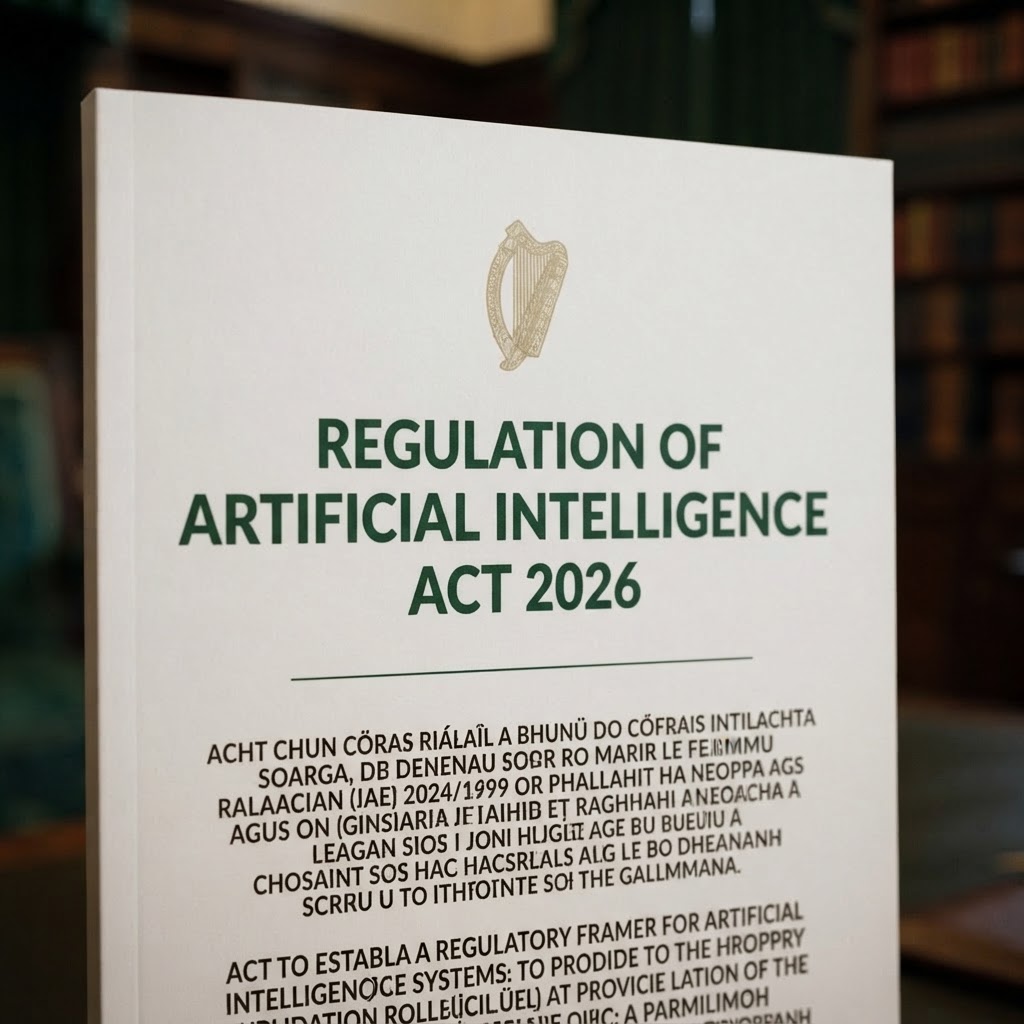
On 21 July 2026, Ireland enacted the Regulation of Artificial Intelligence Act, establishing the institutions and enforcement powers needed to give domestic effect to the European Union's new regulatory regime for artificial intelligence. Ten days later, the AI Office of Ireland began operations. The developments attracted relatively little attention outside legal and regulatory circles, but they represent an important change in the relationship between Irish businesses and the technologies they are increasingly using. AI regulation is acquiring a permanent institutional presence within the State, supported by statutory powers and an established network of supervisory authorities.
The European AI Act has been in force since August 2024, with its obligations becoming applicable in stages. Until now, much of the public discussion has centred on what the Regulation requires: which systems are prohibited, what constitutes high-risk AI, and what responsibilities fall on developers and organisations deploying the technology. Ireland's 2026 legislation addresses another essential part of the regulatory equation. It determines how the European framework will be supervised and enforced within the State.
For Irish organisations, the significance lies in the architecture of the new system. Ireland has chosen to distribute AI supervision across existing regulatory bodies rather than concentrate enforcement in a single new authority. A technology that cuts across employment, financial services, healthcare, consumer protection and public administration will, in substantial part, be supervised through the institutions already familiar with those sectors. The result is a regulatory model in which the use of artificial intelligence becomes part of the established landscape of corporate and public sector accountability.
A new regulatory architecture
The Regulation of Artificial Intelligence Act 2026 establishes Oifig IS na hÉireann, the AI Office of Ireland, as an independent statutory body responsible for coordinating the implementation of the European Regulation. The Office acts as Ireland's central point of contact, supports cooperation between competent authorities and provides access to the technical expertise needed for effective supervision. Its role is particularly important where the use of AI engages the responsibilities of more than one regulator.
The actual supervision of AI systems is distributed according to existing institutional expertise. The Central Bank of Ireland has designated responsibilities for certain high-risk systems and prohibited practices within its remit. The Data Protection Commission has responsibilities in specified areas involving fundamental rights and personal information. The Workplace Relations Commission supervises the deployment and use of AI systems in the labour market, while authorities including the Health Products Regulatory Authority, ComReg and the Competition and Consumer Protection Commission have functions relating to particular categories of regulated products and systems. These responsibilities are defined by the applicable legislation and designations; no individual regulator has a general mandate over every use of AI in its sector.
There is a practical logic to this arrangement. Artificial intelligence is rarely encountered by a business as a discrete regulatory activity. It is introduced into existing processes: assessing creditworthiness, recruiting employees, delivering services, analysing customer information or supporting professional decisions. Each of these activities already operates within a legal environment, and many are subject to established supervisory requirements. The EU AI Act adds obligations directed at the particular risks associated with artificial intelligence, including the possibility that automated systems may affect safety, fundamental rights or access to important services.
Ireland's approach recognises that effective supervision requires an understanding of the activity in which the technology is being used. A regulator examining an AI system used in employment decisions must understand employment law and the consequences of potentially discriminatory outcomes. A regulator supervising AI within a financial product must be capable of assessing its implications within the relevant financial services framework. Technical expertise is essential, but it is not sufficient on its own.
The challenge will be coordination. AI systems frequently cross the boundaries between established regulatory categories, particularly where personal information, automated decision-making and sector-specific obligations intersect. The AI Office has been given a central role in supporting consistent implementation and cooperation between authorities. Whether the distributed model delivers the intended regulatory coherence will depend on how effectively those arrangements operate in practice.
From regulatory principles to enforcement
The domestic legislation gives Ireland the machinery necessary to investigate and respond to breaches of applicable AI Act obligations. It provides for the designation and operation of competent authorities, regulatory supervision, enforcement measures and administrative sanctions, together with procedural protections. Amendments to existing legislation, including the Central Bank Act 1942 and the Competition and Consumer Protection Act 2014, form part of this framework.
The enforcement provisions are significant because the European AI Act is not simply a statement of desirable principles for responsible technology use. It establishes legal obligations, with potentially substantial financial consequences for infringement. The Regulation provides for penalties that, in the most serious categories, may reach €35 million or 7 per cent of worldwide annual turnover, subject to the applicable rules, including proportionality and the particular treatment of smaller enterprises. Those maximum figures should not be mistaken for the likely penalty in an ordinary compliance case, nor do they mean that every organisation using AI faces the same exposure. Liability depends on the specific obligation, the nature of the infringement and the circumstances in which it occurs.
An equally important distinction concerns timing. The commencement of Ireland's domestic enforcement framework does not mean that every substantive provision of the EU AI Act has become applicable. The European Regulation follows a phased timetable, which was amended in July 2026 by Regulation (EU) 2026/1744, commonly referred to as the Digital Omnibus on AI. The principal requirements concerning high-risk systems listed in Annex III are now scheduled to apply from 2 December 2027, while the corresponding requirements for certain product-related high-risk systems under Annex I are scheduled for 2 August 2028. Other obligations, including AI literacy requirements and the original prohibitions on specified unacceptable practices, already apply. Transparency obligations also have their own application and transitional dates.
This timetable matters. Businesses must identify which provisions apply to their particular activities and distinguish existing obligations from those that will become applicable later. The existence of an enforcement authority does not accelerate the legal commencement of an obligation. Equally, the later application of some high-risk requirements does not suspend duties that are already in force.
There is also a distinction between the legal establishment of a regulator and its operational maturity. In a written parliamentary response on 6 October, the Government confirmed that the AI Office was continuing to develop its systems, expertise, relationships and organisational capacity, including arrangements for matters falling within the responsibilities of multiple authorities. Ireland therefore has a statutory regulatory framework in place while elements of the institutional infrastructure continue to develop.
What regulated AI use will require
For businesses, the immediate consequence is the need to understand how AI is being used within their organisations. That may sound straightforward, but AI increasingly enters businesses through ordinary software procurement, productivity applications and features incorporated into existing systems. A company may have introduced several AI-enabled tools without ever making a formal decision to adopt an artificial intelligence system.
Understanding the regulatory position requires more than identifying the software supplier. The EU AI Act distinguishes between different participants in the AI supply chain, including providers and deployers, and assigns obligations according to their roles. An organisation using a third-party system in the course of its business may have responsibilities quite different from those of the company that developed it. Those responsibilities also depend on the system's intended purpose, its classification and the circumstances of its use.
Consider an employer introducing software to assist in assessing job applications. The legal analysis must extend beyond the product's general description or the supplier's assurances. The organisation needs to understand what the system actually does, how it influences employment decisions and whether its intended use falls within a category regulated as high-risk. Questions of employment law, data protection and equality obligations may arise independently of the AI Act's specific requirements.
The same reasoning applies across other sectors, although the legal consequences will differ. A financial institution using AI to assess customers, a healthcare provider introducing AI-supported diagnostic technology and a professional services firm deploying a general-purpose assistant are not necessarily subject to the same obligations. A uniform compliance policy, applied without regard to the nature of the system or the purpose for which it is used, is unlikely to provide an adequate basis for understanding those differences.
For many organisations, the most useful starting point will be a reliable account of the AI systems they use, the decisions those systems support and the information they process. From that foundation, it becomes possible to determine regulatory roles, assess relevant risks, establish appropriate oversight and document the decisions made. Not every measure in such a governance framework is expressly mandated for every AI application. Some are legal requirements; others are prudent organisational controls. Maintaining that distinction is essential to proportionate compliance.
The significance for the legal profession
The new Irish legislation also has implications for the legal profession, both as users of artificial intelligence and as advisers to organisations adopting it.
Solicitors' firms are already subject to professional obligations concerning competence, confidentiality, client information and responsibility for legal work. The introduction of AI into research, drafting, document analysis or client-facing processes must be considered within those existing duties. Where an application also falls within the scope of particular EU AI Act requirements, the relevant obligations must be assessed separately.
For firms advising businesses, the development of domestic enforcement creates a growing area of legal work that crosses established practice boundaries. AI governance can engage data protection, employment law, commercial contracts, consumer protection, regulatory compliance and questions of liability. A business implementing a consequential AI system may require legal advice at several stages, from procurement and classification through to deployment, monitoring and the management of incidents.
There is a broader professional challenge here. Legal advice about AI cannot be reduced to a generic statement that organisations must act responsibly or retain human oversight. The relevant analysis requires an understanding of what the system does, how it is used, the legal obligations engaged and the evidence needed to demonstrate compliance. Lawyers will increasingly need to work alongside technical, operational and compliance professionals to provide advice grounded in the actual circumstances of deployment.
The next stage of implementation
Ireland's regulatory architecture is now taking shape around a technology whose capabilities and applications continue to develop rapidly. The decision to use established supervisory institutions offers the advantage of existing sectoral knowledge, but also creates a substantial coordination task for the AI Office and the authorities responsible for enforcement. The coming period will test how effectively those institutions can translate a complex European regulatory framework into consistent national supervision.
For businesses, the more immediate task is to understand their own use of AI before questions arise about the adequacy of their controls. The legal framework is sufficiently developed to require serious attention, even where particular obligations have later application dates and elements of the supervisory system are still evolving. Organisations that know which systems they use, why they use them and how consequential decisions are supervised will be better placed to respond as regulatory expectations become more established.
The Regulation of Artificial Intelligence Act 2026 marks an important stage in that process. It gives the European framework a domestic institutional structure and locates responsibility for AI oversight within the Irish regulatory system.
The legislation also illustrates a wider development in the governance of emerging technologies. Artificial intelligence is becoming part of ordinary business activity, and its supervision is increasingly being integrated into the legal institutions that govern that activity.
For Irish organisations, AI governance is now part of the established landscape of regulatory responsibility.
Sources and further reading
- Houses of the Oireachtas | 21 July 2026 — Regulation of Artificial Intelligence Act 2026 (No. 31 of 2026)
- AI Office of Ireland | July 2026 — AI Office of Ireland established; Paul Byrne appointed CEO
- AI Office of Ireland — National Competent Authorities
- European Union | 8 July 2026 — Regulation (EU) 2026/1744: Digital Omnibus on AI
- Houses of the Oireachtas | 6 October 2026 — Parliamentary Question No. 180: Cybersecurity Policy
- European Union | 13 June 2024 — Regulation (EU) 2024/1689: Artificial Intelligence Act
About the author
Caroline Malone BL is a practising barrister and co-founder of Praxis Consulting, advising law firms on artificial intelligence strategy, governance and legal workflow transformation.