
Legal tech strategy begins with workflow design rather than software procurement. For several years now, legal technology has promised transformation but often ended up delivering frustration. Especially for small firms, the path from purchase to value can feel riddled with false starts – expensive software that goes unused, complex tools that disrupt more than they improve and innovation projects that quietly stall after week two. What’s missing is not motivation. It’s a map.
The solution is the Susskind Grid. Originally developed by legal futurist Richard Susskind, the Grid offers a deceptively simple framework. Legal work should be broken down by two key dimensions – what the task is, e.g. drafting, research, collaboration, and how it can be delivered e.g., bespoke service, standardised process, systematised workflow or full automation.
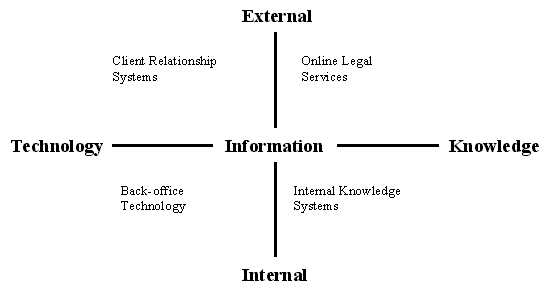
But while the Susskind Grid is conceptually robust, it often remains abstract. What small firms need is localisation – a way to apply this thinking to the daily realities of practise.
Here we lay out a 12 month roadmap for smaller Irish firms to implement legal tech strategically using the Susskind Grid not as an operational playbook.
The Problem with Platform First
Most small firms approach legal tech through the lens of product:
“Should we buy X?”
“Is Y worth the money?”
But this frames the question backwards. Tools don’t create value. Workflows do.
What matters most is not what software you adopt, but what problems you’re solving and how your firm needs to work. The Susskind Grid reorients the conversation. It starts with the task. Then defines the best way to deliver it. Only then do you choose the tool. If you need one at all.
The core Praxis principle applies – Don’t buy platforms. Design outcomes – then tool to fit.
Localising the Grid: The Four Domains That Matter
Here’s how the Susskind Grid maps to real, high-impact areas of a small firm’s work:
Document Automation
What’s changing: Letters of engagement, wills, probate forms, loan packs, litigation pleadings.
Low risk, high return move:
Build a standard template bank with client variables.
Use conditional logic for branching letters e.g. S.68 based on service type.
Tools:
Word based automation e.g. ClauseBuddy, Woodpecker
Even better: a structured intake form which will generates draft letters.
KPI to track:
Time to first draft reduction
Consistency of compliance clauses
Matter Workflows
What’s changing: Intake, KYC, approvals, file opening, closeout.
Low risk, high return move:
Map your current file lifecycle in five steps.
Identify bottlenecks e.g. waiting on ID, chasing approvals.
Turn that into a repeatable process.
Tools:
Workflow engines like Briefed or Clio Grow
Or use a shared checklist and status tracker in Notion or Excel as v1.
KPI to track:
Average onboarding time
% of files opened with full KYC within 48 hours
Collaboration & Communication
What’s changing: How clients are updated, how teams coordinate, how deadlines are tracked.
Low risk, high return move:
Define update cadence by matter type e.g. biweekly in litigation
Assign a comms owner per file.
Standardise the update format.
Tools:
Shared inboxes, client portals, Slack style tools
Even a structured email template is better than ad hoc updates
KPI to track:
Client satisfaction – proxy: reduction in “where are we at?” emails
Write-off % and approval time on drafts
Insight & Supervision
What’s changing: How you spot risk, track time and ensure compliance without micromanagement.
Low risk, high return move:
Create a weekly dashboard: files opened, hours logged, time to respond.
Flag outliers, not everything.
Tools:
Time capture + BI dashboards
A well designed spreadsheet works to start, focus on the questions, not the visuals
KPI to track:
Files >30 days dormant
Partner hours on low value admin (should be trending down)
Your 12 Month Roadmap
0–90 Days: Design Over Decisions
Goals: Map your workflows. Identify friction. Prioritise high-volume, repeatable tasks.
Run a “workflow audit” on 3 common matter types (e.g. conveyancing, probate, litigation)
Document what’s currently manual, repetitive, or inconsistent
Start with one: build a better version using templates + checklists
Don’t buy anything yet. Prototype with what you have.
90–180 Days: Build Light, Launch Fast
Goals: Introduce lightweight automation and tracking.
Introduce 1–2 tools max (e.g. document automation or KYC workflow)
Create a shared “client comms tracker” and update protocol
Run a 4-week trial: track hours saved and client feedback
180–365 Days: Measure and Multiply
Goals: Expand what works. Kill what doesn’t. Make it routine.
Scale the successful workflow to new matter types
Introduce oversight tools (dashboards, exception alerts)
Add rules: “No file opened without KYC done” becomes default, not optional
Bake it into onboarding and training
Workflow Is the Strategy
You don’t need a transformation department or six figure budgets to modernise your firm. What you need is clarity on how you want to work and the discipline to make it repeatable. The Susskind Grid helps you to design the outcome first. Then tools to fit.